Valorant Champions Shanghai, what Day 8 of the group stage revealed about the 2026 title race
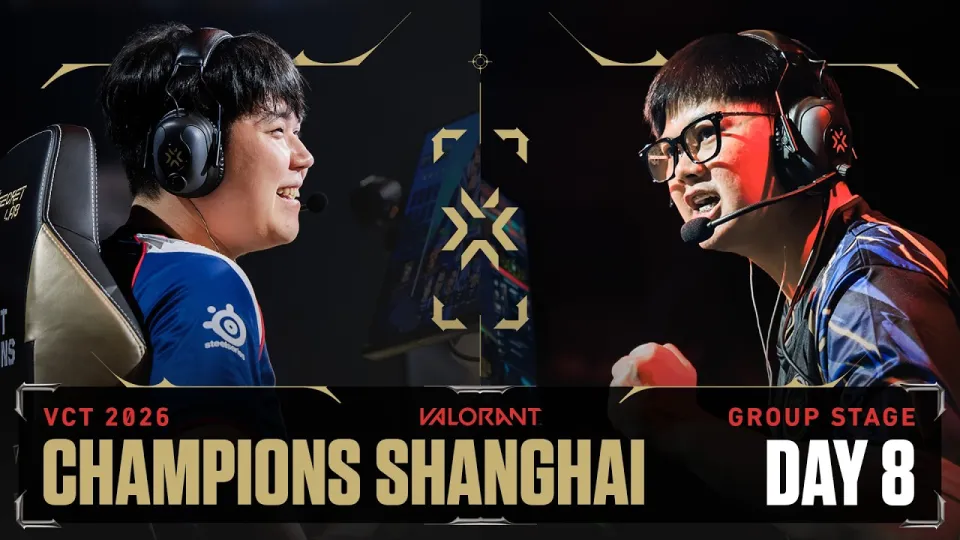
Video: VALORANT Champions Shanghai — Group Stage — Day 8
Want articles like this for your own video to promote it on YouTube and Google? Order them through the Telegram bot @sat_sit_bot. It writes articles around your video, embeds the video and publishes them on popular niche websites (no ads). Your first 50 articles are free.
· based on the channel VALORANT Champions Tour
Valorant Champions Shanghai is the 2026 VALORANT world championship, a 16-team tournament running from September 24 to October 18 that brings together the best rosters from the Americas, CN, EMEA and Pacific regions. Day 8 of the group stage, published by the VALORANT Champions Tour channel, centered on the T1 vs JD Gaming series and the wider question of whether the home region could survive the group stage. For schedules, drops and official updates around the event, the fastest source is the official VALORANT Esports X account.
What Day 8 of the Valorant Champions Shanghai group stage actually contained
Day 8 was a single-series broadcast day built around T1 vs JD Gaming, and the VOD runs well past the four-hour mark. The group stage format at Champions is unforgiving: sixteen teams are split into groups, every match is a best-of-three, and only the top two from each group advance to the playoff bracket. That structure means a single dropped map can decide a team's entire season, which is exactly what happened here.
Key structural facts about the day:
- Game 1 of the T1 vs JD Gaming series began around the 35-minute mark of the broadcast, following the pre-show and analyst desk.
- A technical pause interrupted the first map early, lasting roughly a minute before play resumed.
- The series went the full three maps, with the decider starting in the final hour of the VOD.
- The broadcast included the usual analyst segments, player cams and replay breakdowns that the VCT English desk is known for.
The most discussed moment of the day was not a clutch or an ace. It was JD Gaming's collapse on the opening map, where they held a commanding lead and failed to close it out, eventually losing a map that most viewers had already written off as theirs.
Why the CN region's exit dominated the conversation
All four Chinese teams were eliminated in the group stage of a tournament hosted in Shanghai, and that outcome shaped almost every reaction to the broadcast. On paper, playing at home should be an advantage: no travel, familiar food, a crowd that reacts to every kill. In practice, the CN representatives ran into the same wall they have hit at previous international events — stronger mid-round calling, deeper map pools and more consistent utility usage from the Americas, EMEA and Pacific squads.
The "regional curse" framing that circulated in the comments misses the point. Home advantage does not compensate for a gap in international reps, and CN teams simply had fewer high-pressure series against top-tier opposition going into Champions. JD Gaming came closest to breaking the pattern, and their failure to convert a 6-11 lead on map one is the kind of result that gets remembered longer than a clean 0-2 loss would have been.
The broader structural question is whether the region's dedicated VCT slots are helping or hurting. Guaranteed representation gives CN organizations stability and a reason to invest, but it also means the region's weaknesses are exposed on the biggest stage every single year. Merging back into a wider APAC qualification pool would raise the difficulty of getting to Champions, and it would also raise the floor of the teams that do.
T1 vs JD Gaming: the series that decided the day
The T1 vs JD Gaming series was the only match on the Day 8 schedule, and it carried the entire weight of the CN region's hopes. T1 arrived as the more internationally tested roster, with a deeper playbook and a habit of winning the messy mid-round fights that decide close maps. JD Gaming arrived with home crowd support and nothing to lose.
The first map was the story of the series. JD Gaming built a lead that should have been enough, then watched it evaporate as T1 clawed back round after round. Once the momentum flipped, the rest of the series followed a predictable arc: T1 controlled tempo, JD Gaming scrambled for answers, and the decider was never really competitive. Community reactions after the broadcast were blunt about the third map in particular, with viewers describing JD Gaming's performance there as a collapse rather than a loss.
Individual performances drew scrutiny too. One of the most repeated criticisms concerned T1's agent composition, with viewers questioning why a player known for a more supportive role was placed on a duelist. That kind of flexibility is normal at the top level, but it only works when the rest of the composition compensates, and the broadcast gave plenty of material for both sides of that argument.
The small details viewers could not stop talking about
Small broadcast details often generate more discussion than the scoreline, and Day 8 was no exception. Three topics came up repeatedly.
- The silenced Crown. One of the most-liked comments celebrated a Crown being silenced during the match, a small mechanical moment that viewers found deeply satisfying. It is the kind of detail that only registers if you have played enough VALORANT to know how much a Crown changes a round.
- Hit registration questions. A specific moment in the third map drew complaints that three bullets appeared to connect with an Omen while only two were registered. Whether this was a spectator bug, a tick-rate artifact or a genuine server issue, it is the kind of clip that spreads fast and fuels the perennial debate about consistency in official matches.
- The venue atmosphere. Multiple viewers compared the Shanghai venue to a library, arguing that the crowd noise did not match what you would expect from a home-region team fighting for survival. Whether that is a production mixing issue or a genuinely quieter audience is hard to say from a VOD, but the comparison stuck.
None of these details change the outcome of the series, but they are part of why the Day 8 broadcast is worth watching even if you already know the result. The analyst desk segments, in particular, break down the map one collapse in more detail than the live cast could.
What Day 8 means for the rest of the Valorant Champions Shanghai bracket
Day 8 closed the group stage picture and confirmed that the playoff bracket would be built without any CN representation. That has two immediate consequences for the rest of the tournament.
First, the playoff seeding becomes more predictable. The teams that advanced from the groups containing CN squads got there by beating them, which means the bracket now features a set of rosters that have already proven they can handle a bo3 against a home crowd. That is not nothing — crowd pressure is a real variable at Champions, and teams that survived it in the group stage are better prepared for it in the playoffs.
Second, the narrative around the tournament shifts. With the home region gone, the story becomes about whether the established powers can hold off the newer contenders who have been climbing all season. The event description frames this as a year of broken expectations, with new champions rising at Masters events and the old guard facing a genuinely open field. Day 8 did nothing to settle that question, which is exactly why the playoff rounds matter more than usual.
For anyone tracking the bracket, rosters and schedule, the official channels remain the most reliable source. The VALORANT Esports accounts on X, Facebook, Instagram, TikTok and Twitch post match updates, drops and behind-the-scenes content throughout the event.
Useful links
- Official VALORANT Esports on X: https://x.com/valorantesports
- Official VALORANT Esports on Facebook: https://www.facebook.com/ValorantEsports/
- Official VALORANT Esports on Instagram: https://www.instagram.com/valorantesports/
- Official VALORANT Esports on TikTok: https://www.tiktok.com/@valorantesports
- Official VALORANT Esports on Twitch: https://www.twitch.tv/valorant
The bottom line on Day 8
Day 8 of the Valorant Champions Shanghai group stage delivered one series, one regional collapse and a long list of talking points that will follow the tournament into the playoffs. T1 handled JD Gaming across three maps, JD Gaming let a winnable opening map slip away, and the CN region exited its own home event without a single team in the bracket. The broadcast itself is worth watching for the analyst desk breakdowns of that map one swing, and the VOD is available in full on the VALORANT Champions Tour channel, which produced and published the day's coverage. For live updates, drops and official announcements as the playoffs unfold, follow VALORANT Esports on X.
Key takeaways
- Valorant Champions Shanghai runs September 24 to October 18, with 16 teams from Americas, CN, EMEA and Pacific fighting for the 2026 world title.
- Day 8 of the group stage featured T1 vs JD Gaming, a three-map series that included a tech pause early in Game 1.
- All four CN representatives were eliminated in the group stage, including JD Gaming after they let a big lead slip on the opening map.
- The broadcast was produced by the VALORANT Champions Tour channel and ran over four hours, with matches starting around the 35-minute mark.
- Community reaction focused on the CN region's struggles at home, questionable headshot registration and unusual agent assignments.
Source: VALORANT Champions Shanghai — Group Stage — Day 8 · Markdown version
Questions & answers
How many CN teams made it out of the group stage at Valorant Champions Shanghai?
None. All four Chinese representatives were eliminated during the group stage, including JD Gaming after their loss to T1 on Day 8. It was the second consecutive international event where the region failed to place a team in the playoff bracket, which is why the discussion around CN's dedicated VCT slots has intensified.
Did JD Gaming really have a chance to win their series against T1?
Yes, at least on the opening map. JD Gaming built a 6-11 lead and failed to close it out, which would have been an unusual result for a CN team against a top international opponent. Once T1 completed the comeback, the rest of the series followed T1's tempo and the decider was not close.
Why did viewers complain about hit registration during the broadcast?
A clip in the third map appeared to show three bullets connecting with an Omen while only two were registered as hits. This is a common point of contention in spectator VODs, where server tick rate, replay interpolation and observer perspective can all make damage look different from what the game actually recorded.
Was the Shanghai crowd really as quiet as people said?
Multiple viewers compared the venue to a library, arguing the atmosphere did not match a home-region team fighting for survival. Broadcast audio mixing can make a crowd sound quieter than it is in the arena, so it is hard to judge definitively from a VOD, but the comparison became one of the most repeated reactions to the day.